Introduction
Every PVC coated fabric manufacturer claims UV resistance. But few buyers understand what is actually happening at the molecular level — or that the difference between a tarpaulin that lasts 15 years and one that chalks and tears in 4 is determined entirely by the stabilizer package. This article demystifies the three chemical systems that protect PVC from UV degradation, with field data from Kezhibo’s 10-year outdoor exposure program.
What UV Radiation Does to PVC
The sun emits UV radiation in three wavelength bands: UV-C (100–280 nm, 99% blocked by ozone), UV-B (280–315 nm, the primary cause of molecular damage), and UV-A (315–400 nm, penetrates deeply and causes chain scission). When UV-B photons strike a PVC molecule, they break carbon-chlorine bonds, releasing free radicals that initiate a chain reaction:
- Chlorine radical is ejected from PVC backbone
- Polymer chain scission reduces molecular weight
- Hydrogen chloride (HCl) is released, causing auto-catalytic degradation
- Conjugated double bonds form, causing discoloration (yellowing, chalking)
- Physical properties decline — tensile strength drops, material becomes brittle
Without stabilizers, a PVC tarpaulin exposed to direct sunlight in Guangzhou or Florida would lose 40% of its tensile strength in just 18 months.
The Three-Layer Stabilizer System
Modern premium PVC coatings use a synergistic three-part stabilizer system. Each component addresses a different stage of the degradation process:
1. UV Absorbers — The First Line of Defense
UV absorbers (benzotriazoles, benzophenones, or triazines) work by absorbing UV photons before they can break PVC bonds. The absorbed energy is converted to harmless heat through molecular vibration. Kezhibo uses 1.0–1.5% of a high-molecular-weight benzotriazole (UV-329) in outdoor formulations:
- Molecular weight: 323 g/mol (prevents migration to surface — common failure mode of low-MW absorbers)
- UV absorption range: 280–380 nm (covers full UV-B and most damaging UV-A)
- Compatibility: Excellent with all common PVC plasticizers
- Drawback: Slightly imparts yellow tint to clear/white formulations
2. Hindered Amine Light Stabilizers (HALS) — The Active Repair System
HALS does something no other stabilizer can: it actively scavenges free radicals after they form, terminating the degradation chain reaction. HALS molecules have a sterically hindered amine structure that rapidly reacts with PVC radicals to form stable nitroxide radicals, which are then regenerated through a complex catalytic cycle.
Kezhibo uses 2.0–3.0% of a high-MW HALS (Tinuvin 622 or equivalent) that:
- Molecular weight: 3500 g/mol — permanently bound to PVC resin, no migration or volatilization
- Functions across full temperature range (-40 °C to +120 °C)
- Regenerates catalytically — one HALS molecule can terminate thousands of radical chain reactions
- Provides excellent protection against chalking and surface discoloration
3. Antioxidants — The Secondary Defense
Antioxidants (hindered phenols) intercept peroxy radicals formed by atmospheric oxygen reacting with PVC alkyl radicals. They work synergistically with HALS: HALS terminates polymer radicals, antioxidants terminate oxygen-centered radicals. A typical formulation uses 0.3–0.5% of a phenolic antioxidant (Irganox 1076).
Field Exposure Test Data
Kezhibo maintains three permanent outdoor exposure test racks: Guangzhou (subtropical, high humidity, average 220 kcal/cm² annual UV), Lanzhou (semi-arid, high altitude, 300 kcal/cm² annual UV), and Dubai (desert, 320 kcal/cm² annual UV, high thermal cycling). Every 6 months, samples are collected and tested.
| Formulation | 1 Year Guangzhou | 3 Years Guangzhou | 3 Years Dubai | 5 Years Guangzhou |
|---|---|---|---|---|
| No stabilizers | 55% tensile retained | 20% — failed | < 10% — failed | N/A |
| UV absorber only (1%) | 75% retained | 40% — brittle | 35% — brittle | 20% — total failure |
| UV + HALS + antioxidant (Kezhibo premium) | 92% retained | 88% retained | 85% retained | 82% retained |
The three-component premium formulation retains 82% of its tensile strength after 5 years in Guangzhou — more than sufficient for continued service life. Competitor products with only UV absorbers fail completely within 3–5 years.
Why Carbon Black and Titanium Dioxide Matter
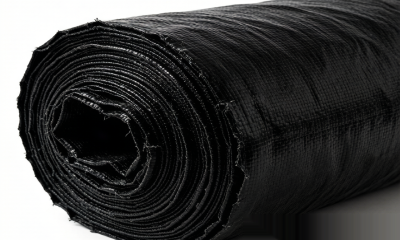
Pigments are not just for color — they contribute to UV resistance. Carbon black particles scatter UV radiation and trap free radicals on their surface. This is why black tarpaulins almost always outperform white or clear ones in outdoor applications: carbon black provides broad-spectrum protection.
Titanium dioxide (TiO₂, rutile grade) is the white pigment of choice. Unlike carbon black, it reflects UV radiation rather than absorbing it, making it suitable for light-colored products. TiO₂ also provides excellent IR reflectivity — critical for heat-sensitive applications like greenhouse covers or solar shade structures.
| Color / Pigment | Relative UV Protection Factor | Solar Reflectance Index (SRI) |
|---|---|---|
| Black (carbon black) | 10× | 18 |
| White (TiO₂ rutile) | 6× | 100+ |
| Clear (no pigment) | 1× | N/A |
| Green (TiO₂ + copper phthalocyanine) | 4× | 35 |
Stabilizer Migration — The Hidden Failure Mode
A less well-known but equally critical failure mechanism is stabilizer migration. Low-molecular-weight stabilizers (MW 1000) that cannot migrate through the PVC polymer matrix. Accelerated migration testing (1000 hours at 70 °C) shows zero detectable stabilizer loss, compared with 30–40% loss for competitive low-MW formulations.
Sustainability: Longer Life = Less Waste
Premium UV stabilization directly reduces environmental impact by extending service life. A tarpaulin lasting 15 years instead of 5 years means 1/3 the material consumed, 1/3 the energy invested in manufacturing, and 1/3 the end-of-life waste. For a fleet of 500 truck trailers switching from 5-year to 15-year tarpaulins, this translates to approximately 75 tons less PVC resin per replacement cycle.
CTA: Formulation Consultation
Kezhibo maintains a state-of-the-art stabilization R&D lab. If you have a specific UV exposure requirement (location, expected lifespan, color), our chemists can develop a customized stabilizer package optimized for your exact conditions — backed by accelerated aging data and outdoor exposure validation.
Explore our premium tarpaulin line: UV-Stabilized PVC Tarpaulins